© 2010 Joshua Stark
Here, then, is the last(ish) blog entry for my 'Lands on the Margin'. I really like the idea, and it's tough to end it as a separate idea from my other blogs. However, if you are interested in the concept, please note that I will be posting 'Lands' entries at my other blog, "Agrarianista."
I've come to realize a couple of things over the past year with regards to my version of home agrarianism and urban homesteading: It involves a strong, well-balanced connection to the local wild lands.
Joel Salatin once noted to Michael Pollan that his farm wasn't just the "productive" acres, but needed the open, wild space where he didn't directly grow anything. Watershed quality was one factor, and I believe the windbreak it provided was another.
I'm no Joel Salatin, but I can parallel the concept, and especially in California. I do some things on my little chunk of land pretty well (I've got duck eggs coming out my hoo-haa), but other things escape the capabilities of my soil (like squashes, interestingly enough).
But, as in the tradition of thousands of years of humans living here (and I count myself abundantly lucky to be grafted to the tree of California history), I rely to a great deal on what the wild has to offer me. In particular, I rely on the things I may forage throughout the year from the edgelands, from figs to river reed.
So, I've moved my blog posts on this concept to my Agrarianista blog. I've also moved my occasional series posts (edible plants, now edible and useful plants, and gear reviews) to stand-alone pages at Agrarianista.
I will also keep the 'Lands on the Margin' blog name and space, just in case.
Wednesday, November 3, 2010

Friday, October 15, 2010
Quick trip to the bypass: Grapes
© 2010 Joshua Stark
My daughter and I took a quick walk onto the Sacramento Bypass, just to see how it looked. Apart from the feral sauna we found (ever heard of craigslist, A-hole!?)...

we also came across some ripe wild grapes:
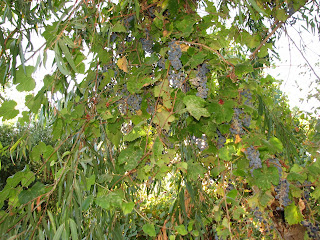
We ate a couple, and if I had the time right now, I'd be back out there picking for grape jelly.
We also came upon these beautiful hooker's evening primrose:


Please excuse the light posting lately, I'm running on little sleep, and looking for work. Tangentially, if you know of any work to be had, shoot me a line.
My daughter and I took a quick walk onto the Sacramento Bypass, just to see how it looked. Apart from the feral sauna we found (ever heard of craigslist, A-hole!?)...

we also came across some ripe wild grapes:

We ate a couple, and if I had the time right now, I'd be back out there picking for grape jelly.
We also came upon these beautiful hooker's evening primrose:


Please excuse the light posting lately, I'm running on little sleep, and looking for work. Tangentially, if you know of any work to be had, shoot me a line.
Wednesday, September 29, 2010
Welcome my boy!
© 2010 Joshua Stark
A quick post, asking you to welcome our new baby boy! Ruben Antonio William Stark, born last Friday. Both Mama and baby are fine, although none of us here have gotten much sleep.
We are now four in our family, and I am constantly amazed at the miracles I've been allowed, and frequently overwhelmed with emotion. This has been one roller coaster of a year...
(note: I don't post pictures of my kids because they are very young. When they are old enough to consent to their photos, I'll do it. Or, maybe if we get some nice portraits done at some point.)
A quick post, asking you to welcome our new baby boy! Ruben Antonio William Stark, born last Friday. Both Mama and baby are fine, although none of us here have gotten much sleep.
We are now four in our family, and I am constantly amazed at the miracles I've been allowed, and frequently overwhelmed with emotion. This has been one roller coaster of a year...
(note: I don't post pictures of my kids because they are very young. When they are old enough to consent to their photos, I'll do it. Or, maybe if we get some nice portraits done at some point.)
Friday, September 24, 2010
Quick note on foraging
© 2010 Joshua Stark
If you haven't yet read it, Hank Shaw has a great post up on his musings about foraging vs. gardening. Very interesting read.
If you haven't yet read it, Hank Shaw has a great post up on his musings about foraging vs. gardening. Very interesting read.
Tuesday, September 7, 2010
Of doves, rabbits, and adventure!
© 2010 Joshua Stark
I must confess, I didn't hunt our dove opener on marginal lands this year. And I paid the price.
Oh, I had ideas. I'd get up before work, a couple of hours before shooting time, even, and head out to the best dove spot on the Sacramento Bypass, a small strip of land adjacent to the California Highway Patrol training facility. I'd do this for two reasons: The opening day shoot there is supposed to be great; and I'd take the good spot where, every year, a bunch of A-holes shoot up the place and leave a pile of shotgun shells.
I don't understand leaving shotgun shells. I'm sure there's some macho territory-marking thing going on, or some macho, I-don't-clean-up-after-myself sort of thing. All it does is make me want to slash tires.
Well, this year I'd be out there before the morons. I'd have a good spot, and maybe a good story to go with it, and I'd be back in the office by startin' time.
Two things changed this year's plans, however. First, I lost my job - so, no need to beat the rush. Second, my cousin and a good friend invited me to hunt a property they paid for access. It's a peach orchard, and they'd been told it's lousy with doves, rabbits, and barnie pigeons. Heck, there'd even be peaches for the pickin'.
So instead of heading up to the bypass, when 4 am rolled around, I was in my cousin's truck heading 90 miles South.
The company was great, we had a wonderful time, and the friend used the word "epic" on at least three occasions. Unfortunately, those occasions were: Just how few doves show up at a place that charges money; the notoriety of my cousin's and my ability to create a 'no game' zone within a 20 mile radius of wherever we choose to hunt; and sadly, the amount of crack a 65-year old man decided to show on his way into the Perko's at breakfast-time.
Known for our hunts being titled, "that time..." (as in, "that time we almost shot those specks"), this became, "that time the a-hole guide stopped us to check our permission slips, and the only shootable dove dropped in over his truck", and also "that time we shot those peaches." Epic is the right word.
But, later in the week things would improve, and they would do so on some marginal lands.
The Department of Fish & Game manages a number of small wildlife areas throughout the state. Often, these areas are little more than leftover parcels and patches jammed between industrial and agriculture centers. I call many of these lands marginal (except the duck hunting spots, of course), even though they are outside city limits and urban centers, because they are on the margins of human activities that dramatically alter the landscape. And what's more impactful, anyway, a thousand acres of sprayed wheat, harvested at nesting time, or a thousand acres of city with parks and trees and backyard bird feeders? It's also not accurate to portray "urban" as ending at the arbitrary political boundary, when that city wouldn't exist without the ribbon of asphalt and those thousand acres of wheat, repeated to epic proportions, throughout the "country". There is no real "urban".
And so I found myself, again with my cousin, hunting up an edgeland. We arrived over an hour late, a bad, bad thing when hunting rabbits with no dog in wild grape and blackberry country. But right at the parking lot we jumped and lost a bunny, so our spirits were buoyed. Walking the edge, we spied a flock of doves (the OED describes that as a, "holy crap!" of doves) on the ground. My cousin put the sneak on 'em and got one. Just over a hillock a rabbit fell to my gun. Another couple hundred yards, and I noticed a little brown shape.
"Is that a..." as I speak, I realize it is a, "rabbit, right" BOOM! "there?"
After that, we paddled over a body of water to a spot a bit more difficult to access if not for the boat. At 8:30 am, an hour after most people around here would have called it a day for rabbits, a cottontail skidded by in front of us. We were so shocked to see a coney this late that we didn't get off a shot.
A great day. I've got rabbits in the freezer, my cousin has a dove to add to his pile, and we have that time we got those two rabbits and a dove.
I should've trusted the marginal lands to provide when I needed them.
I must confess, I didn't hunt our dove opener on marginal lands this year. And I paid the price.
Oh, I had ideas. I'd get up before work, a couple of hours before shooting time, even, and head out to the best dove spot on the Sacramento Bypass, a small strip of land adjacent to the California Highway Patrol training facility. I'd do this for two reasons: The opening day shoot there is supposed to be great; and I'd take the good spot where, every year, a bunch of A-holes shoot up the place and leave a pile of shotgun shells.
I don't understand leaving shotgun shells. I'm sure there's some macho territory-marking thing going on, or some macho, I-don't-clean-up-after-myself sort of thing. All it does is make me want to slash tires.
Well, this year I'd be out there before the morons. I'd have a good spot, and maybe a good story to go with it, and I'd be back in the office by startin' time.
Two things changed this year's plans, however. First, I lost my job - so, no need to beat the rush. Second, my cousin and a good friend invited me to hunt a property they paid for access. It's a peach orchard, and they'd been told it's lousy with doves, rabbits, and barnie pigeons. Heck, there'd even be peaches for the pickin'.
So instead of heading up to the bypass, when 4 am rolled around, I was in my cousin's truck heading 90 miles South.
The company was great, we had a wonderful time, and the friend used the word "epic" on at least three occasions. Unfortunately, those occasions were: Just how few doves show up at a place that charges money; the notoriety of my cousin's and my ability to create a 'no game' zone within a 20 mile radius of wherever we choose to hunt; and sadly, the amount of crack a 65-year old man decided to show on his way into the Perko's at breakfast-time.
Known for our hunts being titled, "that time..." (as in, "that time we almost shot those specks"), this became, "that time the a-hole guide stopped us to check our permission slips, and the only shootable dove dropped in over his truck", and also "that time we shot those peaches." Epic is the right word.
But, later in the week things would improve, and they would do so on some marginal lands.
The Department of Fish & Game manages a number of small wildlife areas throughout the state. Often, these areas are little more than leftover parcels and patches jammed between industrial and agriculture centers. I call many of these lands marginal (except the duck hunting spots, of course), even though they are outside city limits and urban centers, because they are on the margins of human activities that dramatically alter the landscape. And what's more impactful, anyway, a thousand acres of sprayed wheat, harvested at nesting time, or a thousand acres of city with parks and trees and backyard bird feeders? It's also not accurate to portray "urban" as ending at the arbitrary political boundary, when that city wouldn't exist without the ribbon of asphalt and those thousand acres of wheat, repeated to epic proportions, throughout the "country". There is no real "urban".
And so I found myself, again with my cousin, hunting up an edgeland. We arrived over an hour late, a bad, bad thing when hunting rabbits with no dog in wild grape and blackberry country. But right at the parking lot we jumped and lost a bunny, so our spirits were buoyed. Walking the edge, we spied a flock of doves (the OED describes that as a, "holy crap!" of doves) on the ground. My cousin put the sneak on 'em and got one. Just over a hillock a rabbit fell to my gun. Another couple hundred yards, and I noticed a little brown shape.
"Is that a..." as I speak, I realize it is a, "rabbit, right" BOOM! "there?"
After that, we paddled over a body of water to a spot a bit more difficult to access if not for the boat. At 8:30 am, an hour after most people around here would have called it a day for rabbits, a cottontail skidded by in front of us. We were so shocked to see a coney this late that we didn't get off a shot.
A great day. I've got rabbits in the freezer, my cousin has a dove to add to his pile, and we have that time we got those two rabbits and a dove.
I should've trusted the marginal lands to provide when I needed them.
Saturday, August 28, 2010
Edible Plants of California's Edgelands: A giant ficus on the Margin
© 2010 Joshua Stark
Summer in Central California brings some amazing things. Of course, we get the heat - a typical Summer here gives us 22 days over 100 degrees, which means that half of our years have more than 22 days over 100. But, we also get fruit, vegetables, berries, and flowers. For foraging the wild marginal lands, Summer offers up serious bounties of very valuable products - fennel seeds and pollen, and various berries ripened by the heat and fed by generous river systems. This weather also makes for a great place for common figs to grow.

The common fig (Ficus caricar) has a long and distinguished past with people. Among the first plants cultivated by humans, figs have been found in neolithic sites dating back to 9,000 BC, even before evidence of wheat cultivation. Today, hundreds of varieties are grown throughout the warmer parts of the world.
In California, the most commonly met wild fig is a variety called 'mission' or 'black mission'. It is medium-sized, as figs go, and when ripe (Summertime!), turns a beautiful, dark purple and droops down. It's name comes from its origin to the state, as Spanish missions brought the fruit as early as the late 1700's.

Figs are that type of food everything gorges on while it's ripe. Birds, woodland critters, and people all take part in great fig feasts, because very soon, we know they will be withered and gone for a whole year.
Figs are also the type of food that really changes dramatically with preparation. When eaten raw, they are sweet, but not overpoweringly so. When preserved, their sweetness is still there, but there is a stronger presence of other flavors, and an almost smoky quality.
Because they are so loved by creatures great and small, and because they've been cultivated for thousands of years, figs are prolific, and picking can be easy. However, this means that the tree you are eyeballing along the trail has been eyeballed by more than a couple of people, and other species, to boot. And the tree has one problem associated with picking: It's sap can be a terrible irritant, causing sticking, itching, and burning, and on some people, it can even scar. If you are heading out to pick, please wear long-sleeved shirts, pants, and if you are particularly sensitive, even gloves.

Common fig, Ficus caricar
Large, deciduous shrub or small tree of riparian habitats, growing to 30 feet high, almost always in thickets of multiple plants.
Leaves are large, palmate, and deeply lobed with 3-7 lobes. Fruit is a synconium.
Preserved figs
Half as much sugar as figs
One lemon per 60 figs or so, sliced thin
60 figs will make about four pint jars
Pour just enough water to cover the bottom of your pan (really, just a little water), and dump in figs, whole. Cover with sugar.
Set fire on med-med. high, stirring frequently, until it starts to boil. Lower heat some, and simmer, uncovered, 1.5-2 hours, until liquid starts to thicken, stirring occasionally to keep the foam down (it's harder to skim the foam with whole figs in the pot). If the pot is seriously foaming, turn down the heat a bit.
Pour into prepared jars, making sure to get a couple of lemon slices in each jar, and process in boiling water bath (I believe the standard is fifteen minutes, but you'll need to double-check that with a canning expert).
If you can the figs while the liquid is still pretty thin, pour the liquid over the figs, and strain the remaining liquid through a sieve to get rid of the seeds. You now have a small amount of fig syrup, with which you can make this:
Ginger, candied in fig & port wine
One finger of ginger, about one/1.5 in. long
3/4 to 1 Cup each of fig syrup and port wine
Simmer fig syrup on medium heat until it just starts to bubble around the edges, then quickly pour in the port wine. Simmer down a bit, then toss in ginger, sliced wide and thin. Simmer down by at least half. Serve sauce over meats (it goes perfectly with salmon), topped with the ginger.
http://www.hort.purdue.edu/newcrop/morton/fig.html#Toxicity
http://www.grist.org/article/food-fig-cake-and-old-fashioned-preserves/
http://en.wikipedia.org/wiki/Common_fig
Summer in Central California brings some amazing things. Of course, we get the heat - a typical Summer here gives us 22 days over 100 degrees, which means that half of our years have more than 22 days over 100. But, we also get fruit, vegetables, berries, and flowers. For foraging the wild marginal lands, Summer offers up serious bounties of very valuable products - fennel seeds and pollen, and various berries ripened by the heat and fed by generous river systems. This weather also makes for a great place for common figs to grow.

That brighter green thicket holds an overflowing bounty
The common fig (Ficus caricar) has a long and distinguished past with people. Among the first plants cultivated by humans, figs have been found in neolithic sites dating back to 9,000 BC, even before evidence of wheat cultivation. Today, hundreds of varieties are grown throughout the warmer parts of the world.
In California, the most commonly met wild fig is a variety called 'mission' or 'black mission'. It is medium-sized, as figs go, and when ripe (Summertime!), turns a beautiful, dark purple and droops down. It's name comes from its origin to the state, as Spanish missions brought the fruit as early as the late 1700's.

The black mission fig in all its glory
Figs are also the type of food that really changes dramatically with preparation. When eaten raw, they are sweet, but not overpoweringly so. When preserved, their sweetness is still there, but there is a stronger presence of other flavors, and an almost smoky quality.
Because they are so loved by creatures great and small, and because they've been cultivated for thousands of years, figs are prolific, and picking can be easy. However, this means that the tree you are eyeballing along the trail has been eyeballed by more than a couple of people, and other species, to boot. And the tree has one problem associated with picking: It's sap can be a terrible irritant, causing sticking, itching, and burning, and on some people, it can even scar. If you are heading out to pick, please wear long-sleeved shirts, pants, and if you are particularly sensitive, even gloves.

If you can just reach a little further...
--------------------------------------------------------------
Technical-ish description:Common fig, Ficus caricar
Large, deciduous shrub or small tree of riparian habitats, growing to 30 feet high, almost always in thickets of multiple plants.
Leaves are large, palmate, and deeply lobed with 3-7 lobes. Fruit is a synconium.
--------------------------------------------------------------
Recipes:Preserved figs
Half as much sugar as figs
One lemon per 60 figs or so, sliced thin
60 figs will make about four pint jars
Pour just enough water to cover the bottom of your pan (really, just a little water), and dump in figs, whole. Cover with sugar.
Set fire on med-med. high, stirring frequently, until it starts to boil. Lower heat some, and simmer, uncovered, 1.5-2 hours, until liquid starts to thicken, stirring occasionally to keep the foam down (it's harder to skim the foam with whole figs in the pot). If the pot is seriously foaming, turn down the heat a bit.
Pour into prepared jars, making sure to get a couple of lemon slices in each jar, and process in boiling water bath (I believe the standard is fifteen minutes, but you'll need to double-check that with a canning expert).
If you can the figs while the liquid is still pretty thin, pour the liquid over the figs, and strain the remaining liquid through a sieve to get rid of the seeds. You now have a small amount of fig syrup, with which you can make this:
Ginger, candied in fig & port wine
One finger of ginger, about one/1.5 in. long
3/4 to 1 Cup each of fig syrup and port wine
Simmer fig syrup on medium heat until it just starts to bubble around the edges, then quickly pour in the port wine. Simmer down a bit, then toss in ginger, sliced wide and thin. Simmer down by at least half. Serve sauce over meats (it goes perfectly with salmon), topped with the ginger.
--------------------------------------------------------------
Resources:http://www.hort.purdue.edu/newcrop/morton/fig.html#Toxicity
http://www.grist.org/article/food-fig-cake-and-old-fashioned-preserves/
http://en.wikipedia.org/wiki/Common_fig
Tuesday, August 24, 2010
Living off the margins - edible plants of marginal lands
© 2010 Joshua Stark
I'm currently working on an additional page for this blog, titled, "Edible Plants of California's Edgelands". Ideally, I'd like to provide a little primer on the most common plants, where/when to find them, a couple of recipes, and whatnot.
Are any of you interested? Also, what might you like to know?
So far, here's my list: Mallow, filaree, nettles, elders, dandelions, artichokes, fennel, berries, figs.
I'm currently working on an additional page for this blog, titled, "Edible Plants of California's Edgelands". Ideally, I'd like to provide a little primer on the most common plants, where/when to find them, a couple of recipes, and whatnot.
Are any of you interested? Also, what might you like to know?
So far, here's my list: Mallow, filaree, nettles, elders, dandelions, artichokes, fennel, berries, figs.
Subscribe to:
Posts (Atom)