© 2012 Joshua Stark
Here's a short video produced by the amazing Abby on how to prepare nettles to eat. I worked with our native nettle for this one:
Wednesday, April 11, 2012

Tuesday, February 28, 2012
Useful Plants of California's Edgelands: Greens!
© 2012 Joshua Stark
Here at the end of February California's Central Valley is exploding with wonderful food. It's greens time!
Many of California's great greens are non-native invasive plants like thistle, mallow, dandelions, and the ubiquitous mustard and radishes, though a couple of natives can be found, as well (miners' lettuce being the most common).
Most of the broad-leaved plants in your local empty lot are edible, though "edible" depends on a number of factors, taste not the least among them. Here are some tips for collecting greens:
First, identify your plants. Yes, Google is good for that as a start, but there are a couple of decent books out there, too -- most notably Charlotte Bringle Clark's "Edible and Useful Plants of California". Around Sacramento, the only dangerous things you might confuse for greens (that I know of) are hemlock and nightshade, so definitely learn how to identify them.
Second, know your picking spots. While many forage plants are left alone, greens often get sprayed as vile pests. If the flora has unnatural colors, or the habitat has unnaturally geometric patterns (say, a straight line of wilted plants), you can be pretty sure that they've been sprayed. Also, the closest edges of roads tend to get pollution and spraying, and are often yellowed or brown, and stunted.
Now that you've gone around your neighborhood and noticed all the mustard, what next? Taste it. Many plants have different flavors, depending on their location, soil, Sun, and air. I have found mustard plants that would challenge even horseradish for wonderful pungency, and others that tasted a little bit blander than grass. Also, don't pick old plants. An old "green" is one that has flowered at some point in its life, and size doesn't determine age. If the plants are just about to flower, you've hit the greens jackpot. Pick those tops (Hank calls 'em wild broccoli raab) as well as the leaves. Make sure that what you are picking is worth picking by eating a bit of it. (If you are worried about a little dirt, then why are you out here picking wild stuff?!!) If it's good, load up.
When picking, don't pick the parts you'll just cut off later, anyway. Pick the leaf up to the point where the stem starts to get tough.
I've found that about 3/4th's-ful of a paper bag is good for our family of four. Remember, greens often cook down - lose volume - and that they wilt quickly. Cook them the same day and freeze them if you must, or eat them then and there or within the next couple of days.
Recipes:
Here at the end of February California's Central Valley is exploding with wonderful food. It's greens time!
 |
| Late Winter, California Delta. Note the leafless grapevines, and the thick patch of greens. |
Many of California's great greens are non-native invasive plants like thistle, mallow, dandelions, and the ubiquitous mustard and radishes, though a couple of natives can be found, as well (miners' lettuce being the most common).
 |
| A couple of different greens here: milk thistle, wild radish and mustard. |
Most of the broad-leaved plants in your local empty lot are edible, though "edible" depends on a number of factors, taste not the least among them. Here are some tips for collecting greens:
First, identify your plants. Yes, Google is good for that as a start, but there are a couple of decent books out there, too -- most notably Charlotte Bringle Clark's "Edible and Useful Plants of California". Around Sacramento, the only dangerous things you might confuse for greens (that I know of) are hemlock and nightshade, so definitely learn how to identify them.
Second, know your picking spots. While many forage plants are left alone, greens often get sprayed as vile pests. If the flora has unnatural colors, or the habitat has unnaturally geometric patterns (say, a straight line of wilted plants), you can be pretty sure that they've been sprayed. Also, the closest edges of roads tend to get pollution and spraying, and are often yellowed or brown, and stunted.
 |
| Mustard plant, right up against the road... probably not a plant to forage. (Photo credit to my five year old daughter.) |
Now that you've gone around your neighborhood and noticed all the mustard, what next? Taste it. Many plants have different flavors, depending on their location, soil, Sun, and air. I have found mustard plants that would challenge even horseradish for wonderful pungency, and others that tasted a little bit blander than grass. Also, don't pick old plants. An old "green" is one that has flowered at some point in its life, and size doesn't determine age. If the plants are just about to flower, you've hit the greens jackpot. Pick those tops (Hank calls 'em wild broccoli raab) as well as the leaves. Make sure that what you are picking is worth picking by eating a bit of it. (If you are worried about a little dirt, then why are you out here picking wild stuff?!!) If it's good, load up.
When picking, don't pick the parts you'll just cut off later, anyway. Pick the leaf up to the point where the stem starts to get tough.
I've found that about 3/4th's-ful of a paper bag is good for our family of four. Remember, greens often cook down - lose volume - and that they wilt quickly. Cook them the same day and freeze them if you must, or eat them then and there or within the next couple of days.
----------------------------------------------------
Technical-ish description:
Greens are found in various plant families. In California's Central Valley, the most common are probably wild mustard (Brassica campestris) and radish and wild radish (Raphanus sativa, R. raphanistrum), both in the family Brassicaceae, a very edible family. Size varies greatly, but the best foraging plants will be 18" to three feet tall, with big, broad leaves.
----------------------------------------------------
Recipes:
Cook wild greens like you would domestic greens, and realize that if you bought dandelions or mustard, you probably could have picked their equivalents for free. Traditionally, greens are boiled with a ham hock or smoked neck bones, although if you want a vegetarian version, use vegetable bouillon and smoked salt. Saute' an onion and a couple of cloves of garlic in butter or oil for a few minutes, then add the washed and cut greens, stirring them all together. Add a cup or so of stock or water, add the bones if using them, (If you like spice, add red pepper flakes now, too) and cook, covered, for 15-20 minutes.
A tip for quicker preparation: If you picked them without the tough stems, you've won half the battle. When washing them, grab a few leaves at a time, run them in water, then roll them up lengthwise and squeeze the water out of them. Keep them rolled and cut them in 1/2" strips starting from the top.
Saturday, August 27, 2011
Useful plants of California's Edgelands: Electric Grass, the marginal lands super-food!
© 2011 Joshua Stark

When I first learned that stinging nettles were not only edible, but delicious and extra-nutritious, I was surprised.
You see, like any sane person, I'd never handled stinging nettle on purpose, before - when you grow up next to a plant everybody calls "electric grass", you tend to stay away. But my foraging master friends, Hank Shaw over at Hunter, Angler, Gardener, Cook, and Kari at the Erratic Crafter were both so jazzed to hear about the plethora of nettles on the Delta that I was quickly convinced to run out and pick some.
I also did a little research (if Google can be called "research") on the nutritional value of nettles. I found differing accounts of their value (thanks, Internet), anywhere from 20-40% protein, with high levels of vitamins A, B, and C, and possibly some minerals. I'm no nutritionist, but I do know that greens are good for ya.
Pick nettles when they are young, and take the top 4-6" of the plant. Nettles require some special equipment for picking - namely, a glove or two, snips, and a bag. Their stinging hairs contain formic acid, which can cause itching, swelling and burning, and I'm fairly certain that it isn't an allergic reaction, it's actual damage, so don't mess with them.
Preparing nettles is easy; here is what Hank taught me:
Get a big ol' pot of saltwater boiling, and a big ol' bowl of icewater. Throw in (with the tongs! Use the tongs!) a bunch of the nettles, and let them cook up for about 20-30 seconds. Pull them out, and plunge them into the icewater, to preserve their color. Next, roll them up into tea towels, wring 'em out, vacuum seal and freeze.
Nettles are a great green growing generously at your local marginal land, I'm sure. So, next time you are walking the dog by that patch of nettles at the edge of the park, take note, and come back when the little ones are just coming up. You can get yourself a real treat, and get to freak out your friends and family at the same time.

When I first learned that stinging nettles were not only edible, but delicious and extra-nutritious, I was surprised.
You see, like any sane person, I'd never handled stinging nettle on purpose, before - when you grow up next to a plant everybody calls "electric grass", you tend to stay away. But my foraging master friends, Hank Shaw over at Hunter, Angler, Gardener, Cook, and Kari at the Erratic Crafter were both so jazzed to hear about the plethora of nettles on the Delta that I was quickly convinced to run out and pick some.
I also did a little research (if Google can be called "research") on the nutritional value of nettles. I found differing accounts of their value (thanks, Internet), anywhere from 20-40% protein, with high levels of vitamins A, B, and C, and possibly some minerals. I'm no nutritionist, but I do know that greens are good for ya.
Pick nettles when they are young, and take the top 4-6" of the plant. Nettles require some special equipment for picking - namely, a glove or two, snips, and a bag. Their stinging hairs contain formic acid, which can cause itching, swelling and burning, and I'm fairly certain that it isn't an allergic reaction, it's actual damage, so don't mess with them.
 |
| Carefully... carefully... |
Preparing nettles is easy; here is what Hank taught me:
Get a big ol' pot of saltwater boiling, and a big ol' bowl of icewater. Throw in (with the tongs! Use the tongs!) a bunch of the nettles, and let them cook up for about 20-30 seconds. Pull them out, and plunge them into the icewater, to preserve their color. Next, roll them up into tea towels, wring 'em out, vacuum seal and freeze.
Nettles are a great green growing generously at your local marginal land, I'm sure. So, next time you are walking the dog by that patch of nettles at the edge of the park, take note, and come back when the little ones are just coming up. You can get yourself a real treat, and get to freak out your friends and family at the same time.
----------------------------------------------------
Technical-ish description:
Nettles, Urtica dioica (stinging nettle), Urtica urens (common or dwarf nettle)
A small to medium (10"- 8 ft.) plant growing in single, straight stalks. Dwarf nettle resembles short mint, with small, deep green leaves and square stalks. It does not, however, taste like mint, especially right off the plant! Stinging nettles grow tall, often in ditches or near water sources in California, and their leaves and stalks are lighter green and very hairy.
----------------------------------------------------
Recipes:
Nettles can replace spinach in any recipe. They are much milder than spinach, but their nutritional qualities, color and texture are similar. I use them in egg dishes.
Scrambled eggs and nettles:
2 eggs
1/4 Cup milk
1/4 Cup prepared nettles
1/2 Tb. butter
Salt and pepper to taste
Scramble the eggs with the milk and nettles.
Heat a skillet on medium, add butter, and when just melted and sizzling, pour in the eggs. Turn down to low, and watch. When the eggs bubble for a bit, chop and turn them in the pan. When they reach the consistency you like, turn off the heat and put 'em on a plate. Obviously, this recipe is for folks who don't have a great deal of experience in the kitchen.
Hank Shaw has a great page on nettles, and Langdon Cook has quite a few recipes, too - including ingenious "nettle pesto pops".
Wednesday, November 3, 2010
The end of this line...kinda
© 2010 Joshua Stark
Here, then, is the last(ish) blog entry for my 'Lands on the Margin'. I really like the idea, and it's tough to end it as a separate idea from my other blogs. However, if you are interested in the concept, please note that I will be posting 'Lands' entries at my other blog, "Agrarianista."
I've come to realize a couple of things over the past year with regards to my version of home agrarianism and urban homesteading: It involves a strong, well-balanced connection to the local wild lands.
Joel Salatin once noted to Michael Pollan that his farm wasn't just the "productive" acres, but needed the open, wild space where he didn't directly grow anything. Watershed quality was one factor, and I believe the windbreak it provided was another.
I'm no Joel Salatin, but I can parallel the concept, and especially in California. I do some things on my little chunk of land pretty well (I've got duck eggs coming out my hoo-haa), but other things escape the capabilities of my soil (like squashes, interestingly enough).
But, as in the tradition of thousands of years of humans living here (and I count myself abundantly lucky to be grafted to the tree of California history), I rely to a great deal on what the wild has to offer me. In particular, I rely on the things I may forage throughout the year from the edgelands, from figs to river reed.
So, I've moved my blog posts on this concept to my Agrarianista blog. I've also moved my occasional series posts (edible plants, now edible and useful plants, and gear reviews) to stand-alone pages at Agrarianista.
I will also keep the 'Lands on the Margin' blog name and space, just in case.
Here, then, is the last(ish) blog entry for my 'Lands on the Margin'. I really like the idea, and it's tough to end it as a separate idea from my other blogs. However, if you are interested in the concept, please note that I will be posting 'Lands' entries at my other blog, "Agrarianista."
I've come to realize a couple of things over the past year with regards to my version of home agrarianism and urban homesteading: It involves a strong, well-balanced connection to the local wild lands.
Joel Salatin once noted to Michael Pollan that his farm wasn't just the "productive" acres, but needed the open, wild space where he didn't directly grow anything. Watershed quality was one factor, and I believe the windbreak it provided was another.
I'm no Joel Salatin, but I can parallel the concept, and especially in California. I do some things on my little chunk of land pretty well (I've got duck eggs coming out my hoo-haa), but other things escape the capabilities of my soil (like squashes, interestingly enough).
But, as in the tradition of thousands of years of humans living here (and I count myself abundantly lucky to be grafted to the tree of California history), I rely to a great deal on what the wild has to offer me. In particular, I rely on the things I may forage throughout the year from the edgelands, from figs to river reed.
So, I've moved my blog posts on this concept to my Agrarianista blog. I've also moved my occasional series posts (edible plants, now edible and useful plants, and gear reviews) to stand-alone pages at Agrarianista.
I will also keep the 'Lands on the Margin' blog name and space, just in case.
Friday, October 15, 2010
Quick trip to the bypass: Grapes
© 2010 Joshua Stark
My daughter and I took a quick walk onto the Sacramento Bypass, just to see how it looked. Apart from the feral sauna we found (ever heard of craigslist, A-hole!?)...

we also came across some ripe wild grapes:
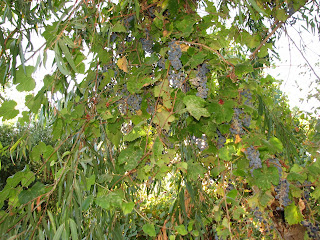
We ate a couple, and if I had the time right now, I'd be back out there picking for grape jelly.
We also came upon these beautiful hooker's evening primrose:


Please excuse the light posting lately, I'm running on little sleep, and looking for work. Tangentially, if you know of any work to be had, shoot me a line.
My daughter and I took a quick walk onto the Sacramento Bypass, just to see how it looked. Apart from the feral sauna we found (ever heard of craigslist, A-hole!?)...

we also came across some ripe wild grapes:

We ate a couple, and if I had the time right now, I'd be back out there picking for grape jelly.
We also came upon these beautiful hooker's evening primrose:


Please excuse the light posting lately, I'm running on little sleep, and looking for work. Tangentially, if you know of any work to be had, shoot me a line.
Wednesday, September 29, 2010
Welcome my boy!
© 2010 Joshua Stark
A quick post, asking you to welcome our new baby boy! Ruben Antonio William Stark, born last Friday. Both Mama and baby are fine, although none of us here have gotten much sleep.
We are now four in our family, and I am constantly amazed at the miracles I've been allowed, and frequently overwhelmed with emotion. This has been one roller coaster of a year...
(note: I don't post pictures of my kids because they are very young. When they are old enough to consent to their photos, I'll do it. Or, maybe if we get some nice portraits done at some point.)
A quick post, asking you to welcome our new baby boy! Ruben Antonio William Stark, born last Friday. Both Mama and baby are fine, although none of us here have gotten much sleep.
We are now four in our family, and I am constantly amazed at the miracles I've been allowed, and frequently overwhelmed with emotion. This has been one roller coaster of a year...
(note: I don't post pictures of my kids because they are very young. When they are old enough to consent to their photos, I'll do it. Or, maybe if we get some nice portraits done at some point.)
Friday, September 24, 2010
Quick note on foraging
© 2010 Joshua Stark
If you haven't yet read it, Hank Shaw has a great post up on his musings about foraging vs. gardening. Very interesting read.
If you haven't yet read it, Hank Shaw has a great post up on his musings about foraging vs. gardening. Very interesting read.
Tuesday, September 7, 2010
Of doves, rabbits, and adventure!
© 2010 Joshua Stark
I must confess, I didn't hunt our dove opener on marginal lands this year. And I paid the price.
Oh, I had ideas. I'd get up before work, a couple of hours before shooting time, even, and head out to the best dove spot on the Sacramento Bypass, a small strip of land adjacent to the California Highway Patrol training facility. I'd do this for two reasons: The opening day shoot there is supposed to be great; and I'd take the good spot where, every year, a bunch of A-holes shoot up the place and leave a pile of shotgun shells.
I don't understand leaving shotgun shells. I'm sure there's some macho territory-marking thing going on, or some macho, I-don't-clean-up-after-myself sort of thing. All it does is make me want to slash tires.
Well, this year I'd be out there before the morons. I'd have a good spot, and maybe a good story to go with it, and I'd be back in the office by startin' time.
Two things changed this year's plans, however. First, I lost my job - so, no need to beat the rush. Second, my cousin and a good friend invited me to hunt a property they paid for access. It's a peach orchard, and they'd been told it's lousy with doves, rabbits, and barnie pigeons. Heck, there'd even be peaches for the pickin'.
So instead of heading up to the bypass, when 4 am rolled around, I was in my cousin's truck heading 90 miles South.
The company was great, we had a wonderful time, and the friend used the word "epic" on at least three occasions. Unfortunately, those occasions were: Just how few doves show up at a place that charges money; the notoriety of my cousin's and my ability to create a 'no game' zone within a 20 mile radius of wherever we choose to hunt; and sadly, the amount of crack a 65-year old man decided to show on his way into the Perko's at breakfast-time.
Known for our hunts being titled, "that time..." (as in, "that time we almost shot those specks"), this became, "that time the a-hole guide stopped us to check our permission slips, and the only shootable dove dropped in over his truck", and also "that time we shot those peaches." Epic is the right word.
But, later in the week things would improve, and they would do so on some marginal lands.
The Department of Fish & Game manages a number of small wildlife areas throughout the state. Often, these areas are little more than leftover parcels and patches jammed between industrial and agriculture centers. I call many of these lands marginal (except the duck hunting spots, of course), even though they are outside city limits and urban centers, because they are on the margins of human activities that dramatically alter the landscape. And what's more impactful, anyway, a thousand acres of sprayed wheat, harvested at nesting time, or a thousand acres of city with parks and trees and backyard bird feeders? It's also not accurate to portray "urban" as ending at the arbitrary political boundary, when that city wouldn't exist without the ribbon of asphalt and those thousand acres of wheat, repeated to epic proportions, throughout the "country". There is no real "urban".
And so I found myself, again with my cousin, hunting up an edgeland. We arrived over an hour late, a bad, bad thing when hunting rabbits with no dog in wild grape and blackberry country. But right at the parking lot we jumped and lost a bunny, so our spirits were buoyed. Walking the edge, we spied a flock of doves (the OED describes that as a, "holy crap!" of doves) on the ground. My cousin put the sneak on 'em and got one. Just over a hillock a rabbit fell to my gun. Another couple hundred yards, and I noticed a little brown shape.
"Is that a..." as I speak, I realize it is a, "rabbit, right" BOOM! "there?"
After that, we paddled over a body of water to a spot a bit more difficult to access if not for the boat. At 8:30 am, an hour after most people around here would have called it a day for rabbits, a cottontail skidded by in front of us. We were so shocked to see a coney this late that we didn't get off a shot.
A great day. I've got rabbits in the freezer, my cousin has a dove to add to his pile, and we have that time we got those two rabbits and a dove.
I should've trusted the marginal lands to provide when I needed them.
I must confess, I didn't hunt our dove opener on marginal lands this year. And I paid the price.
Oh, I had ideas. I'd get up before work, a couple of hours before shooting time, even, and head out to the best dove spot on the Sacramento Bypass, a small strip of land adjacent to the California Highway Patrol training facility. I'd do this for two reasons: The opening day shoot there is supposed to be great; and I'd take the good spot where, every year, a bunch of A-holes shoot up the place and leave a pile of shotgun shells.
I don't understand leaving shotgun shells. I'm sure there's some macho territory-marking thing going on, or some macho, I-don't-clean-up-after-myself sort of thing. All it does is make me want to slash tires.
Well, this year I'd be out there before the morons. I'd have a good spot, and maybe a good story to go with it, and I'd be back in the office by startin' time.
Two things changed this year's plans, however. First, I lost my job - so, no need to beat the rush. Second, my cousin and a good friend invited me to hunt a property they paid for access. It's a peach orchard, and they'd been told it's lousy with doves, rabbits, and barnie pigeons. Heck, there'd even be peaches for the pickin'.
So instead of heading up to the bypass, when 4 am rolled around, I was in my cousin's truck heading 90 miles South.
The company was great, we had a wonderful time, and the friend used the word "epic" on at least three occasions. Unfortunately, those occasions were: Just how few doves show up at a place that charges money; the notoriety of my cousin's and my ability to create a 'no game' zone within a 20 mile radius of wherever we choose to hunt; and sadly, the amount of crack a 65-year old man decided to show on his way into the Perko's at breakfast-time.
Known for our hunts being titled, "that time..." (as in, "that time we almost shot those specks"), this became, "that time the a-hole guide stopped us to check our permission slips, and the only shootable dove dropped in over his truck", and also "that time we shot those peaches." Epic is the right word.
But, later in the week things would improve, and they would do so on some marginal lands.
The Department of Fish & Game manages a number of small wildlife areas throughout the state. Often, these areas are little more than leftover parcels and patches jammed between industrial and agriculture centers. I call many of these lands marginal (except the duck hunting spots, of course), even though they are outside city limits and urban centers, because they are on the margins of human activities that dramatically alter the landscape. And what's more impactful, anyway, a thousand acres of sprayed wheat, harvested at nesting time, or a thousand acres of city with parks and trees and backyard bird feeders? It's also not accurate to portray "urban" as ending at the arbitrary political boundary, when that city wouldn't exist without the ribbon of asphalt and those thousand acres of wheat, repeated to epic proportions, throughout the "country". There is no real "urban".
And so I found myself, again with my cousin, hunting up an edgeland. We arrived over an hour late, a bad, bad thing when hunting rabbits with no dog in wild grape and blackberry country. But right at the parking lot we jumped and lost a bunny, so our spirits were buoyed. Walking the edge, we spied a flock of doves (the OED describes that as a, "holy crap!" of doves) on the ground. My cousin put the sneak on 'em and got one. Just over a hillock a rabbit fell to my gun. Another couple hundred yards, and I noticed a little brown shape.
"Is that a..." as I speak, I realize it is a, "rabbit, right" BOOM! "there?"
After that, we paddled over a body of water to a spot a bit more difficult to access if not for the boat. At 8:30 am, an hour after most people around here would have called it a day for rabbits, a cottontail skidded by in front of us. We were so shocked to see a coney this late that we didn't get off a shot.
A great day. I've got rabbits in the freezer, my cousin has a dove to add to his pile, and we have that time we got those two rabbits and a dove.
I should've trusted the marginal lands to provide when I needed them.
Saturday, August 28, 2010
Edible Plants of California's Edgelands: A giant ficus on the Margin
© 2010 Joshua Stark
Summer in Central California brings some amazing things. Of course, we get the heat - a typical Summer here gives us 22 days over 100 degrees, which means that half of our years have more than 22 days over 100. But, we also get fruit, vegetables, berries, and flowers. For foraging the wild marginal lands, Summer offers up serious bounties of very valuable products - fennel seeds and pollen, and various berries ripened by the heat and fed by generous river systems. This weather also makes for a great place for common figs to grow.

The common fig (Ficus caricar) has a long and distinguished past with people. Among the first plants cultivated by humans, figs have been found in neolithic sites dating back to 9,000 BC, even before evidence of wheat cultivation. Today, hundreds of varieties are grown throughout the warmer parts of the world.
In California, the most commonly met wild fig is a variety called 'mission' or 'black mission'. It is medium-sized, as figs go, and when ripe (Summertime!), turns a beautiful, dark purple and droops down. It's name comes from its origin to the state, as Spanish missions brought the fruit as early as the late 1700's.

Figs are that type of food everything gorges on while it's ripe. Birds, woodland critters, and people all take part in great fig feasts, because very soon, we know they will be withered and gone for a whole year.
Figs are also the type of food that really changes dramatically with preparation. When eaten raw, they are sweet, but not overpoweringly so. When preserved, their sweetness is still there, but there is a stronger presence of other flavors, and an almost smoky quality.
Because they are so loved by creatures great and small, and because they've been cultivated for thousands of years, figs are prolific, and picking can be easy. However, this means that the tree you are eyeballing along the trail has been eyeballed by more than a couple of people, and other species, to boot. And the tree has one problem associated with picking: It's sap can be a terrible irritant, causing sticking, itching, and burning, and on some people, it can even scar. If you are heading out to pick, please wear long-sleeved shirts, pants, and if you are particularly sensitive, even gloves.

Common fig, Ficus caricar
Large, deciduous shrub or small tree of riparian habitats, growing to 30 feet high, almost always in thickets of multiple plants.
Leaves are large, palmate, and deeply lobed with 3-7 lobes. Fruit is a synconium.
Preserved figs
Half as much sugar as figs
One lemon per 60 figs or so, sliced thin
60 figs will make about four pint jars
Pour just enough water to cover the bottom of your pan (really, just a little water), and dump in figs, whole. Cover with sugar.
Set fire on med-med. high, stirring frequently, until it starts to boil. Lower heat some, and simmer, uncovered, 1.5-2 hours, until liquid starts to thicken, stirring occasionally to keep the foam down (it's harder to skim the foam with whole figs in the pot). If the pot is seriously foaming, turn down the heat a bit.
Pour into prepared jars, making sure to get a couple of lemon slices in each jar, and process in boiling water bath (I believe the standard is fifteen minutes, but you'll need to double-check that with a canning expert).
If you can the figs while the liquid is still pretty thin, pour the liquid over the figs, and strain the remaining liquid through a sieve to get rid of the seeds. You now have a small amount of fig syrup, with which you can make this:
Ginger, candied in fig & port wine
One finger of ginger, about one/1.5 in. long
3/4 to 1 Cup each of fig syrup and port wine
Simmer fig syrup on medium heat until it just starts to bubble around the edges, then quickly pour in the port wine. Simmer down a bit, then toss in ginger, sliced wide and thin. Simmer down by at least half. Serve sauce over meats (it goes perfectly with salmon), topped with the ginger.
http://www.hort.purdue.edu/newcrop/morton/fig.html#Toxicity
http://www.grist.org/article/food-fig-cake-and-old-fashioned-preserves/
http://en.wikipedia.org/wiki/Common_fig
Summer in Central California brings some amazing things. Of course, we get the heat - a typical Summer here gives us 22 days over 100 degrees, which means that half of our years have more than 22 days over 100. But, we also get fruit, vegetables, berries, and flowers. For foraging the wild marginal lands, Summer offers up serious bounties of very valuable products - fennel seeds and pollen, and various berries ripened by the heat and fed by generous river systems. This weather also makes for a great place for common figs to grow.

That brighter green thicket holds an overflowing bounty
The common fig (Ficus caricar) has a long and distinguished past with people. Among the first plants cultivated by humans, figs have been found in neolithic sites dating back to 9,000 BC, even before evidence of wheat cultivation. Today, hundreds of varieties are grown throughout the warmer parts of the world.
In California, the most commonly met wild fig is a variety called 'mission' or 'black mission'. It is medium-sized, as figs go, and when ripe (Summertime!), turns a beautiful, dark purple and droops down. It's name comes from its origin to the state, as Spanish missions brought the fruit as early as the late 1700's.

The black mission fig in all its glory
Figs are also the type of food that really changes dramatically with preparation. When eaten raw, they are sweet, but not overpoweringly so. When preserved, their sweetness is still there, but there is a stronger presence of other flavors, and an almost smoky quality.
Because they are so loved by creatures great and small, and because they've been cultivated for thousands of years, figs are prolific, and picking can be easy. However, this means that the tree you are eyeballing along the trail has been eyeballed by more than a couple of people, and other species, to boot. And the tree has one problem associated with picking: It's sap can be a terrible irritant, causing sticking, itching, and burning, and on some people, it can even scar. If you are heading out to pick, please wear long-sleeved shirts, pants, and if you are particularly sensitive, even gloves.

If you can just reach a little further...
--------------------------------------------------------------
Technical-ish description:Common fig, Ficus caricar
Large, deciduous shrub or small tree of riparian habitats, growing to 30 feet high, almost always in thickets of multiple plants.
Leaves are large, palmate, and deeply lobed with 3-7 lobes. Fruit is a synconium.
--------------------------------------------------------------
Recipes:Preserved figs
Half as much sugar as figs
One lemon per 60 figs or so, sliced thin
60 figs will make about four pint jars
Pour just enough water to cover the bottom of your pan (really, just a little water), and dump in figs, whole. Cover with sugar.
Set fire on med-med. high, stirring frequently, until it starts to boil. Lower heat some, and simmer, uncovered, 1.5-2 hours, until liquid starts to thicken, stirring occasionally to keep the foam down (it's harder to skim the foam with whole figs in the pot). If the pot is seriously foaming, turn down the heat a bit.
Pour into prepared jars, making sure to get a couple of lemon slices in each jar, and process in boiling water bath (I believe the standard is fifteen minutes, but you'll need to double-check that with a canning expert).
If you can the figs while the liquid is still pretty thin, pour the liquid over the figs, and strain the remaining liquid through a sieve to get rid of the seeds. You now have a small amount of fig syrup, with which you can make this:
Ginger, candied in fig & port wine
One finger of ginger, about one/1.5 in. long
3/4 to 1 Cup each of fig syrup and port wine
Simmer fig syrup on medium heat until it just starts to bubble around the edges, then quickly pour in the port wine. Simmer down a bit, then toss in ginger, sliced wide and thin. Simmer down by at least half. Serve sauce over meats (it goes perfectly with salmon), topped with the ginger.
--------------------------------------------------------------
Resources:http://www.hort.purdue.edu/newcrop/morton/fig.html#Toxicity
http://www.grist.org/article/food-fig-cake-and-old-fashioned-preserves/
http://en.wikipedia.org/wiki/Common_fig
Tuesday, August 24, 2010
Living off the margins - edible plants of marginal lands
© 2010 Joshua Stark
I'm currently working on an additional page for this blog, titled, "Edible Plants of California's Edgelands". Ideally, I'd like to provide a little primer on the most common plants, where/when to find them, a couple of recipes, and whatnot.
Are any of you interested? Also, what might you like to know?
So far, here's my list: Mallow, filaree, nettles, elders, dandelions, artichokes, fennel, berries, figs.
I'm currently working on an additional page for this blog, titled, "Edible Plants of California's Edgelands". Ideally, I'd like to provide a little primer on the most common plants, where/when to find them, a couple of recipes, and whatnot.
Are any of you interested? Also, what might you like to know?
So far, here's my list: Mallow, filaree, nettles, elders, dandelions, artichokes, fennel, berries, figs.
Friday, August 13, 2010
Marginal hunting seasons
© 2010 Joshua Stark
Another quick note. Here in California, many are surprised at how early we start hunting deer. Our archery seasons for much of the coast began in July, and our other regions' seasons are about to get started.
However, I thought I'd point out that more than just deer are available for folks with sticks and strings in our Golden State. The archery season for tree squirrels began August 1st, and archery quail season starts this Sunday, August 15th! Of course, rabbits have been open for hunting since July 1, and hares are open year-round.
Yes, these are marginal hunting opportunities, and many would scoff at the idea of trying to arrow any bird short of a turkey (which, by the way, is as easy to hunt with a bow as with a shotgun). But, there are a number of fun and interesting hunting arrowheads specifically for prey such as quail. The most common option is the Judo Point, a great head by Zwickey Archery, but they make a better bird point with the Kondor Point - a Judo Point with longer wires.
One can also hunt with Snaro points, which consist of metal cables looped forward, sticking out a few inches on either side. These heads catch birds.
The good features of these heads include less arrow loss from slipping away, and a wider striking area, allowing for more room for error. With these animals, you are aiming for something about the same size as the vitals on bigger game, and with the extra help from these fun points, your odds get even better - so try not to be so intimidated. Also remember that you are out to fling arrows, see some beautiful country, and quietly scout for rifle and shotgun seasons, but if you EVER come home with a successful hunt, you will be the envy of your friends, and prouder'n a peacock, to boot!
This year, I hope to get out once with my recurve and some small game points after birds and squirrels and rabbits. Maybe I'll see you out there.
Another quick note. Here in California, many are surprised at how early we start hunting deer. Our archery seasons for much of the coast began in July, and our other regions' seasons are about to get started.
However, I thought I'd point out that more than just deer are available for folks with sticks and strings in our Golden State. The archery season for tree squirrels began August 1st, and archery quail season starts this Sunday, August 15th! Of course, rabbits have been open for hunting since July 1, and hares are open year-round.
Yes, these are marginal hunting opportunities, and many would scoff at the idea of trying to arrow any bird short of a turkey (which, by the way, is as easy to hunt with a bow as with a shotgun). But, there are a number of fun and interesting hunting arrowheads specifically for prey such as quail. The most common option is the Judo Point, a great head by Zwickey Archery, but they make a better bird point with the Kondor Point - a Judo Point with longer wires.
One can also hunt with Snaro points, which consist of metal cables looped forward, sticking out a few inches on either side. These heads catch birds.
The good features of these heads include less arrow loss from slipping away, and a wider striking area, allowing for more room for error. With these animals, you are aiming for something about the same size as the vitals on bigger game, and with the extra help from these fun points, your odds get even better - so try not to be so intimidated. Also remember that you are out to fling arrows, see some beautiful country, and quietly scout for rifle and shotgun seasons, but if you EVER come home with a successful hunt, you will be the envy of your friends, and prouder'n a peacock, to boot!
This year, I hope to get out once with my recurve and some small game points after birds and squirrels and rabbits. Maybe I'll see you out there.
Tuesday, August 10, 2010
Working... buffering... stalling...
There is a lot going on now, and I'm on pause here for the moment. While I do that, please enjoy this piece on archery over at the Suburban Bushwacker.
Wednesday, June 30, 2010
Non-food foraging
© 2010 Joshua Stark
...and I don't mean dumpster-diving, or continuing to click on the craigslist "free" category (I've already blogged about that one). I'm talking about foraging for things that don't make food, but provide other benefits.
Here in the California Delta, we are cursed with Arundo donax, giant river reed. This plant is highly invasive, and provides no habitat for our native fauna. It also poisons the ground around it, making for a negative habitat space, in effect. However, the gigantic reeds make for fine lattices and trellises. In my tiny town along the river, I grew up next door to master filipino gardeners, who made amazing-looking trellises in the form of five to six-foot tall lean-tos: the cucumbers and beans would hang straight down off of the roofs, where one could easily walk underneath and pick them at eye level.
We also have wild roses, whose shoots can make beautiful and sturdy arrows, and willows, with which one may make a chair, or a concoction for getting clippings to take root. And the abundant local tules and rushes had been used for centuries by native Californians for everything from houses to boats to duck decoys. Soon, I hope to gather some up and try my hand at making decoys, just to see if all the hype in the duck-hunting industry has been overblown.
The occasional walnut tree makes its presence, too, including one 65-foot monster in our back yard. Now, as the squirrels rain down our beautiful walnuts too early to eat, I hope to gather them up and boil down a concoction into walnut stain to make just about anything dark brown - wood, but also pants, hands, our porch. The stuff "works", that's for sure.
Have you ever foraged for things other than food? Often, our little out-of-the-way spots hold treasures that can save you some money, or contribute free loot to a new hobby.
...and I don't mean dumpster-diving, or continuing to click on the craigslist "free" category (I've already blogged about that one). I'm talking about foraging for things that don't make food, but provide other benefits.
Here in the California Delta, we are cursed with Arundo donax, giant river reed. This plant is highly invasive, and provides no habitat for our native fauna. It also poisons the ground around it, making for a negative habitat space, in effect. However, the gigantic reeds make for fine lattices and trellises. In my tiny town along the river, I grew up next door to master filipino gardeners, who made amazing-looking trellises in the form of five to six-foot tall lean-tos: the cucumbers and beans would hang straight down off of the roofs, where one could easily walk underneath and pick them at eye level.
We also have wild roses, whose shoots can make beautiful and sturdy arrows, and willows, with which one may make a chair, or a concoction for getting clippings to take root. And the abundant local tules and rushes had been used for centuries by native Californians for everything from houses to boats to duck decoys. Soon, I hope to gather some up and try my hand at making decoys, just to see if all the hype in the duck-hunting industry has been overblown.
The occasional walnut tree makes its presence, too, including one 65-foot monster in our back yard. Now, as the squirrels rain down our beautiful walnuts too early to eat, I hope to gather them up and boil down a concoction into walnut stain to make just about anything dark brown - wood, but also pants, hands, our porch. The stuff "works", that's for sure.
Have you ever foraged for things other than food? Often, our little out-of-the-way spots hold treasures that can save you some money, or contribute free loot to a new hobby.
Friday, June 25, 2010
Continuing ideas
© 2010 Joshua Stark
A couple weeks back, I asked if folks had any ideas for my new venture, and I received a couple (thanks, fellas!). I'm working on more specific thoughts now, and I've found a gentleman who is going to help me work out the kinks and ideas as a person new to the scene, a potential client. I wrote about where I found him at Ethics & the Environment. After speaking with him, I got some good ideas I'd like to share here.
flx1247rg
Here's my plan so far: A six-week series of four-hour meetings once/week, to cover the basics of foraging in the regional wild lands, fishing (with basic paddling instructions), hunting (with firearms and archery safety and the chance to shoot), food prep and storage, and some visits to local farms and gardens to get tips and ideas on small-scale farming at home (including animals, of course). The classes will come with some basic information in a three-ring binder, with pages on some local plants and animals, seasonality, links to better information, etc. I also hope to provide classes on basic birdwatching, botany, field sketching, photography, things to do in the field with kids, first aid, etc.
I'm not saying I can do all of these things (I can do a few), but where I can't (like photography), I'd like to schedule folks to come in who can (like Holly or my amazing friend David Lamfrom).
What do y'all think? How much should I charge for something like this? I'm thinking that with a six-week series, folks can sign up for individual classes, or sign up for the whole series at a discount.
Let me know if I'm even barking up the right tree here.
A couple weeks back, I asked if folks had any ideas for my new venture, and I received a couple (thanks, fellas!). I'm working on more specific thoughts now, and I've found a gentleman who is going to help me work out the kinks and ideas as a person new to the scene, a potential client. I wrote about where I found him at Ethics & the Environment. After speaking with him, I got some good ideas I'd like to share here.
flx1247rg
Here's my plan so far: A six-week series of four-hour meetings once/week, to cover the basics of foraging in the regional wild lands, fishing (with basic paddling instructions), hunting (with firearms and archery safety and the chance to shoot), food prep and storage, and some visits to local farms and gardens to get tips and ideas on small-scale farming at home (including animals, of course). The classes will come with some basic information in a three-ring binder, with pages on some local plants and animals, seasonality, links to better information, etc. I also hope to provide classes on basic birdwatching, botany, field sketching, photography, things to do in the field with kids, first aid, etc.
I'm not saying I can do all of these things (I can do a few), but where I can't (like photography), I'd like to schedule folks to come in who can (like Holly or my amazing friend David Lamfrom).
What do y'all think? How much should I charge for something like this? I'm thinking that with a six-week series, folks can sign up for individual classes, or sign up for the whole series at a discount.
Let me know if I'm even barking up the right tree here.
Thursday, June 17, 2010
There is no Spoon - when 'Spoon' is 'Urban' - and sometimes that is very sad
© 2010 Joshua Stark
Yesterday, on my way home for lunch, a body on the side of the road made my blood run cold. I hit the brakes and pulled off to the side, jumped out of the car, and walked over to it - my worst suspicions came to pass.
It was a dead badger.
Now, this might not sound like a big deal to many of you, especially those living in the Great Basin region. But here, in California's Central Valley, badgers are very uncommon. Also, American badgers are not the kind of animal that thrives on the edge-lands. Badgers are Big Country animals. So it came as a complete shock to me to find a dead one on a main thoroughfare in a city of over 40,000 (and part of a metropolitan area of over 1 million), across a bridge with heavy traffic.
To really understand my surprise, consider this: I have never, in my entire life, seen a badger here. By "here" I mean my homeland, I mean in my thirty-five years of stomping around the Delta. Never. Not once.
I still don't know what to make of finding this critter. On the ground, I am heartbroken. Here is a symbol of the wild wild, a real beast that would and should be snorting and hissing, clawing through the ground, being tough and scary, standing up to creatures many times its size with a legendary strength of will and muscle. As a child, my cousin, friends and I used to play "animal", and inevitably one of us would call out that they were now a badger, and crawl around low, fighting everybody else. But here lay this one, its huge claws uselessly tucked under its chin, it's beautiful fur matted by blood, its fierce green fire long gone from its eyes.
Of course, in the grander scheme of things, I see this beautiful creature's presence as yet another truth against the way we've tried to organize, separate, and catalog our lives. As I've written at my Ethics & the Environment blog, there are no real distinctions between urban, rural, and wild, and a badger in the city is one more example, though it comes at great cost.
Where I am confused is in what this means for the area. Are badgers back, and their numbers so large that now one shows up in town? I'd like to think this is true. Are they getting so much pressure that they are actually moving into marginal lands? Maybe I just don't know badgers very well, and they are successful enough to survive on the margins while never being seen? Perhaps, even, this one was somebody's pet - though I seriously doubt that one.
So I'm left befuddled, but with a real reason to poke around even deeper into my local marginal lands, looking for badger sign. Hopefully, I'll find some, but with enough distance to not get torn to ribbons. I'll keep you posted.
Yesterday, on my way home for lunch, a body on the side of the road made my blood run cold. I hit the brakes and pulled off to the side, jumped out of the car, and walked over to it - my worst suspicions came to pass.
It was a dead badger.
Now, this might not sound like a big deal to many of you, especially those living in the Great Basin region. But here, in California's Central Valley, badgers are very uncommon. Also, American badgers are not the kind of animal that thrives on the edge-lands. Badgers are Big Country animals. So it came as a complete shock to me to find a dead one on a main thoroughfare in a city of over 40,000 (and part of a metropolitan area of over 1 million), across a bridge with heavy traffic.
To really understand my surprise, consider this: I have never, in my entire life, seen a badger here. By "here" I mean my homeland, I mean in my thirty-five years of stomping around the Delta. Never. Not once.
I still don't know what to make of finding this critter. On the ground, I am heartbroken. Here is a symbol of the wild wild, a real beast that would and should be snorting and hissing, clawing through the ground, being tough and scary, standing up to creatures many times its size with a legendary strength of will and muscle. As a child, my cousin, friends and I used to play "animal", and inevitably one of us would call out that they were now a badger, and crawl around low, fighting everybody else. But here lay this one, its huge claws uselessly tucked under its chin, it's beautiful fur matted by blood, its fierce green fire long gone from its eyes.
Of course, in the grander scheme of things, I see this beautiful creature's presence as yet another truth against the way we've tried to organize, separate, and catalog our lives. As I've written at my Ethics & the Environment blog, there are no real distinctions between urban, rural, and wild, and a badger in the city is one more example, though it comes at great cost.
Where I am confused is in what this means for the area. Are badgers back, and their numbers so large that now one shows up in town? I'd like to think this is true. Are they getting so much pressure that they are actually moving into marginal lands? Maybe I just don't know badgers very well, and they are successful enough to survive on the margins while never being seen? Perhaps, even, this one was somebody's pet - though I seriously doubt that one.
So I'm left befuddled, but with a real reason to poke around even deeper into my local marginal lands, looking for badger sign. Hopefully, I'll find some, but with enough distance to not get torn to ribbons. I'll keep you posted.
Monday, June 14, 2010
Gear on the Margin: Rifles for the Marginal Lands
© Joshua Stark
As with my archery and shotgun posts, I'm getting into some controversial stuff here. So, before I explain, and before my caveats, I'll just flat-out say it: For most North American hunting, and for the vast majority of the marginal lands, the 30-30 Winchester lever-action rifle is the best gun.
"What!?!" you probably say. But, I'll say it again: The 30-30 Winchester is the best gun.
Now, take a deep breath, and let me explain.
Today's gun market is awash in the latest and greatest, hottest and hardest hittin', flat-shootinest rounds, guns, and accessories EVER. And I know I am, effectively, a thirty-year old 90-year-old man, a curmudgeonly sort. But, I make no apologies about my love for the 30-30, for it's effectiveness, and for the good it can do to the deer-hunting world.
Usually, articles about the 30-30 Winchester spend the first couple of paragraphs talking about how maligned, out-of-date, and picked-on this 115 yr. old round is, and how its bad rap is unjustified. Then, they talk about how it is getting a 're-model' or some other such thing, in effect talking like it really is a bad round in desperate need of this latest makeover. They mention loading spitzer-type bullets, or the new LeveRevolution, both fine ideas, but the glaring omissions belie the authors' (and community's) belief that the 30-30 is a sub-par arm for hunting.
Baloney! As commonly stated, the 30-30 has probably taken more deer than any other round in North America. It is often touted as a person's first gun, due as much to the availability of ammunition and rifles, its excellent cost-to-quality ratio, as to the light recoil. I'd be willing to bet that the majority of folks got a 30-30 as their first rifle because it was either already in the house, or it was the one they could afford after Summer work, and that, for their hard-earned dollars, it was the best deer rifle.
The titles of most of these articles also have the words "close-quarter", "close range", "quick-action brush gun", or some other comment about the idea that this gun won't kill a deer outside of 100 yds. I won't tell you here that you can tap a dik-dik at 400 yds. on a breezy day with it. What I will say is that probably nine in ten shots taken at deer in this country are inside 100 yds., and one in twenty hunters has any business trying to shoot a deer outside 100 yds, anyway.
An 80-yard shot is not a "close-quarters" "brush" shot, it is a good distance to get to for a good, solid shot. Selling a gun by convincing the buyer that they need to consider 300+ yards is unethical without knowing the person's capabilities.
My opinion? If you are worried about power, first get the tag and the guide lined up for that Alberta moose hunt or trip to Kodiak Island for the bear of a lifetime, then buy the .375 H&H magnum, although you won't want to shoot it. If you are worried about distance, practice stalking. Hunters still take spooky game in open country with real bows, like these folks.
But, if you want a good, solid deer gun that will regularly hit what you aim at without inflicting about the same amount of damage in both directions, and if you want a gun that is fun to carry in the field and not fussy, then just reach under your bed or into your closet and grab your 30-30, and hunt.
You all have read about my preference for American made products, and the 30-30 lever gun had become a temporary casualty of outsourcing. Thankfully, this is no longer the case: A few years ago, Mossberg bought the designs for the Winchester, made some modifications, and manufactures a beautiful gun with the same lines as the old Model 94 (and Ranger, like mine).
When I was 15 and looking for a gun, I wasn't really looking. I wanted a Winchester lever-action 30-30. After 15-plus years owning this gun, I'm more glad than ever that I bought it.
As for it's abilities on marginal lands, the 30-30 beats any competition for the same reason I prefer a double-barreled shotgun on marginal lands - versatility. The 30-30's lower power and weight benefit the hunter who may chance across rabbits to deer. .22's are great guns, as are 30-06's, but really only a couple of calibers overlap between small and large game (anybody still shooting .243's?). And, with the glaring exception of non-lead rounds (which are available, but not readily so), one can find 30-30 ammo just about anywhere.
Its lines are classic. Its feel, balance, and shootability are unmatched, regardless of price. It handles light without being whippy. Its action never fails. It is the prettiest gun I own. I did have my choice of rifles when I decided on the Ranger model, and I picked it because its magazine tube was shorter than the Model 94, and its wood was darker and nicer, both cosmetic choices, but my taste in rifles hasn't changed over time.
Do I hunt with other rifles? Absolutely. I take a .270 Savage model 110E out after pigs, and I love that tack-driving gun, but I don't practice with it enough to justify a shot outside of 150 yards right now with it, either. And the 30-30 is prettier than any bolt gun, but especially that broom-handle stocked beast.
I will not apologize for taking my 30-30 lever gun after blacktails or mulies, and neither should you. It is the best marginal lands gun ever built.

As with my archery and shotgun posts, I'm getting into some controversial stuff here. So, before I explain, and before my caveats, I'll just flat-out say it: For most North American hunting, and for the vast majority of the marginal lands, the 30-30 Winchester lever-action rifle is the best gun.
"What!?!" you probably say. But, I'll say it again: The 30-30 Winchester is the best gun.
Now, take a deep breath, and let me explain.
Today's gun market is awash in the latest and greatest, hottest and hardest hittin', flat-shootinest rounds, guns, and accessories EVER. And I know I am, effectively, a thirty-year old 90-year-old man, a curmudgeonly sort. But, I make no apologies about my love for the 30-30, for it's effectiveness, and for the good it can do to the deer-hunting world.
Usually, articles about the 30-30 Winchester spend the first couple of paragraphs talking about how maligned, out-of-date, and picked-on this 115 yr. old round is, and how its bad rap is unjustified. Then, they talk about how it is getting a 're-model' or some other such thing, in effect talking like it really is a bad round in desperate need of this latest makeover. They mention loading spitzer-type bullets, or the new LeveRevolution, both fine ideas, but the glaring omissions belie the authors' (and community's) belief that the 30-30 is a sub-par arm for hunting.
Baloney! As commonly stated, the 30-30 has probably taken more deer than any other round in North America. It is often touted as a person's first gun, due as much to the availability of ammunition and rifles, its excellent cost-to-quality ratio, as to the light recoil. I'd be willing to bet that the majority of folks got a 30-30 as their first rifle because it was either already in the house, or it was the one they could afford after Summer work, and that, for their hard-earned dollars, it was the best deer rifle.
The titles of most of these articles also have the words "close-quarter", "close range", "quick-action brush gun", or some other comment about the idea that this gun won't kill a deer outside of 100 yds. I won't tell you here that you can tap a dik-dik at 400 yds. on a breezy day with it. What I will say is that probably nine in ten shots taken at deer in this country are inside 100 yds., and one in twenty hunters has any business trying to shoot a deer outside 100 yds, anyway.
An 80-yard shot is not a "close-quarters" "brush" shot, it is a good distance to get to for a good, solid shot. Selling a gun by convincing the buyer that they need to consider 300+ yards is unethical without knowing the person's capabilities.
My opinion? If you are worried about power, first get the tag and the guide lined up for that Alberta moose hunt or trip to Kodiak Island for the bear of a lifetime, then buy the .375 H&H magnum, although you won't want to shoot it. If you are worried about distance, practice stalking. Hunters still take spooky game in open country with real bows, like these folks.
But, if you want a good, solid deer gun that will regularly hit what you aim at without inflicting about the same amount of damage in both directions, and if you want a gun that is fun to carry in the field and not fussy, then just reach under your bed or into your closet and grab your 30-30, and hunt.
You all have read about my preference for American made products, and the 30-30 lever gun had become a temporary casualty of outsourcing. Thankfully, this is no longer the case: A few years ago, Mossberg bought the designs for the Winchester, made some modifications, and manufactures a beautiful gun with the same lines as the old Model 94 (and Ranger, like mine).
When I was 15 and looking for a gun, I wasn't really looking. I wanted a Winchester lever-action 30-30. After 15-plus years owning this gun, I'm more glad than ever that I bought it.
As for it's abilities on marginal lands, the 30-30 beats any competition for the same reason I prefer a double-barreled shotgun on marginal lands - versatility. The 30-30's lower power and weight benefit the hunter who may chance across rabbits to deer. .22's are great guns, as are 30-06's, but really only a couple of calibers overlap between small and large game (anybody still shooting .243's?). And, with the glaring exception of non-lead rounds (which are available, but not readily so), one can find 30-30 ammo just about anywhere.
Its lines are classic. Its feel, balance, and shootability are unmatched, regardless of price. It handles light without being whippy. Its action never fails. It is the prettiest gun I own. I did have my choice of rifles when I decided on the Ranger model, and I picked it because its magazine tube was shorter than the Model 94, and its wood was darker and nicer, both cosmetic choices, but my taste in rifles hasn't changed over time.
Do I hunt with other rifles? Absolutely. I take a .270 Savage model 110E out after pigs, and I love that tack-driving gun, but I don't practice with it enough to justify a shot outside of 150 yards right now with it, either. And the 30-30 is prettier than any bolt gun, but especially that broom-handle stocked beast.
I will not apologize for taking my 30-30 lever gun after blacktails or mulies, and neither should you. It is the best marginal lands gun ever built.

Monday, June 7, 2010
Into the Great Wide Open
© 2010 Joshua Stark
When Hank and Holly accept a foraging invite from me, the only guarantee is a good time.
Some of you may recall the last big trip I suckered... er, invited Holly and Hank into taking with me, to the nearly utterly lifeless and barren Pacific Ocean. Or, at least that's what one would have thought, had their first experience of it been a fishing/foraging trip with me.
flx1247rg
This time, I convinced the dynamic duo that we may be able to find gooseberries. I was supremely confident in their location, as I'd stumbled upon the remains of gooseberries last September while hunting the wily mounain quail (Oreortyx pictus). If you've never seen mountain quail, they are simply the most amazing upland game bird species in California. Hunters, think chukar with bramble and thick fir forest cover. Nonhunters, imagine a bird, a slate-gray breast, with brown and white bands along its sides, about 1/3rd bigger than valley quail, and with a perfect metaphor for its behavior atop its head: Instead of the apostrophe worn by valley quail, mountain quail wear an exclamation mark at a jaunty angle.
My hunting trip last year, fruitless as per usual, had me stomping through some spiny shrubbery - new growth from a fire few years back. As I poked around, I noticed red, spikey berry hulls on the ground, and dessicated berries attached to small, ground-hugging plants growing among the thorny bushes. Back home, the book identified them as sierra gooseberries (Ribes roezlii).
Later in the year, I mentioned in passing to a couple of foraging fiends, Hank and Kari (at Erratic Sewer & Crafter), that I'd found a good stand of gooseberries. They both had the same reaction - giddy excitement. Next year, they said, we'd like to have a look-see at your gooseberry spot.
This spot is in a National Forest in the Sierra Nevada (if you want more specifics, keep wantin'), which begs the question: Is this a marginal land? Well, yes and no. You see, we often treat National Forest lands like a cross between a National Park and BLM land, probably because BLM lands are often scrubby partial plots with non-native weeds and the like, whereas our National Forests are, well, forests.
However, National Forest lands are managed by the USDA, whereas BLM lands, like National Park units, are within the Dept. of Interior. Being agricultural lands, national forests are often logged and grazed. The Forest Service's mission, "to sustain the health, diversity, and productivity of the Nation’s forests and grasslands to meet the needs of present and future generations", makes plain the management goals of these lands.
I'm not going to get into the arguments here (maybe at Ethics and the Environment I will) over private profiting on public lands, fuels reduction, etc. I will note that the particular patch of land I was taking Hank and Holly had been ravaged by catastrophic wildfire a few years back. These reasons make me feel like this is a marginal land.
"Catastrophic" is an important distinction, too. California habitats need fire to thrive. Fires clean out dead and diseased plants, revitalize soils, change the effects of sunlight and water in places, and are even needed to open some seed pods. Native California grasses evolved with fires and moving herds of browsers, and many have developed tight structures above their roots, slower growth, a perennial nature, and less prolific seeding. A fire passing through native California habitat usually burns slowly and with low intensity, as it comes up against those tight, green bunch-grasses. It burns up forest duff (dead leaves and branches), leaving open patches of soil with light layers of ash, while leaving the upper canopies untouched and the mature trees alive. Soon after, seedlings sprout in the rich soil.
Catastrophic fires alter the landscape in far different, unnatural ways.
A catastrophic wildfire is driven by non-native invasive plants, grasses in particular. Non-native grasses, introduced with the Spaniards and others, evolved with farmed animals that live sedentary, local lives. European grasses live fast and die young, seeding quickly and browning. Oftentimes, they grow tall, too. Fires burning through these grasses find thick fuels that reach into the soil. Coupled with an effective 150 years of fire suppression, fires today in the Sierra Nevada find feet of duff, branches and entire dead trees extending up into the canopies, and dead native grasses through the open stretches. They burn super-hot, they burn deep into the soil, and they burn into the crowns of trees. When they finally burn out, they leave soils with no microbial activity, no living mature trees to cover the ground from rains and soak up water with roots. Quickly, erosion rips away soil and ash, and non-native seeds infiltrate, especially along logging roads where car tires and clearing operations bring them in.
Along our stretch of forest, where mountain springs feed little gulleys and crevices, some trees survived. Under these remaining canopies we found our bounties. Though not yet finished flowering, the gooseberries and currants are thick. The elderberries, too, have taken up some of the open spaces, though they've yet to even leaf-out.
And Hank found morels.
We picked maybe a pound of the delicious mushrooms, whose aroma out of the ground reminded me of the freshest trout. Hank also picked some fir tips for a crazy syrup experiment. Later, on some other marginal lands down the Hill, we also found wild mint, and a cloud of so many ladybugs that a couple of them mistook me and Holly for aphids. Being bitten by a ladybug is about as bad as it sounds, but it was shocking.
The mountains and foothills we covered were iconic for their landscapes: Big Country, with 10,000 ft. snow-capped peaks in the background, and a raging, blown-out river in Spring thaw far down the canyon. Many songbirds had arrived, though the squirrels were still silent and the raptors (save for a lone prairie falcon) and band-tailed pigeons must have still been in the lowlands. We didn't hit up any streams for trout, nor drop a crawdad trap in a reservoir, nor (of course) hunt anything this time. Heck, we barely scratched the surface.
We will definitely be back.
When Hank and Holly accept a foraging invite from me, the only guarantee is a good time.
Some of you may recall the last big trip I suckered... er, invited Holly and Hank into taking with me, to the nearly utterly lifeless and barren Pacific Ocean. Or, at least that's what one would have thought, had their first experience of it been a fishing/foraging trip with me.
flx1247rg
This time, I convinced the dynamic duo that we may be able to find gooseberries. I was supremely confident in their location, as I'd stumbled upon the remains of gooseberries last September while hunting the wily mounain quail (Oreortyx pictus). If you've never seen mountain quail, they are simply the most amazing upland game bird species in California. Hunters, think chukar with bramble and thick fir forest cover. Nonhunters, imagine a bird, a slate-gray breast, with brown and white bands along its sides, about 1/3rd bigger than valley quail, and with a perfect metaphor for its behavior atop its head: Instead of the apostrophe worn by valley quail, mountain quail wear an exclamation mark at a jaunty angle.
My hunting trip last year, fruitless as per usual, had me stomping through some spiny shrubbery - new growth from a fire few years back. As I poked around, I noticed red, spikey berry hulls on the ground, and dessicated berries attached to small, ground-hugging plants growing among the thorny bushes. Back home, the book identified them as sierra gooseberries (Ribes roezlii).
Later in the year, I mentioned in passing to a couple of foraging fiends, Hank and Kari (at Erratic Sewer & Crafter), that I'd found a good stand of gooseberries. They both had the same reaction - giddy excitement. Next year, they said, we'd like to have a look-see at your gooseberry spot.
This spot is in a National Forest in the Sierra Nevada (if you want more specifics, keep wantin'), which begs the question: Is this a marginal land? Well, yes and no. You see, we often treat National Forest lands like a cross between a National Park and BLM land, probably because BLM lands are often scrubby partial plots with non-native weeds and the like, whereas our National Forests are, well, forests.
However, National Forest lands are managed by the USDA, whereas BLM lands, like National Park units, are within the Dept. of Interior. Being agricultural lands, national forests are often logged and grazed. The Forest Service's mission, "to sustain the health, diversity, and productivity of the Nation’s forests and grasslands to meet the needs of present and future generations", makes plain the management goals of these lands.
I'm not going to get into the arguments here (maybe at Ethics and the Environment I will) over private profiting on public lands, fuels reduction, etc. I will note that the particular patch of land I was taking Hank and Holly had been ravaged by catastrophic wildfire a few years back. These reasons make me feel like this is a marginal land.
"Catastrophic" is an important distinction, too. California habitats need fire to thrive. Fires clean out dead and diseased plants, revitalize soils, change the effects of sunlight and water in places, and are even needed to open some seed pods. Native California grasses evolved with fires and moving herds of browsers, and many have developed tight structures above their roots, slower growth, a perennial nature, and less prolific seeding. A fire passing through native California habitat usually burns slowly and with low intensity, as it comes up against those tight, green bunch-grasses. It burns up forest duff (dead leaves and branches), leaving open patches of soil with light layers of ash, while leaving the upper canopies untouched and the mature trees alive. Soon after, seedlings sprout in the rich soil.
Catastrophic fires alter the landscape in far different, unnatural ways.
A catastrophic wildfire is driven by non-native invasive plants, grasses in particular. Non-native grasses, introduced with the Spaniards and others, evolved with farmed animals that live sedentary, local lives. European grasses live fast and die young, seeding quickly and browning. Oftentimes, they grow tall, too. Fires burning through these grasses find thick fuels that reach into the soil. Coupled with an effective 150 years of fire suppression, fires today in the Sierra Nevada find feet of duff, branches and entire dead trees extending up into the canopies, and dead native grasses through the open stretches. They burn super-hot, they burn deep into the soil, and they burn into the crowns of trees. When they finally burn out, they leave soils with no microbial activity, no living mature trees to cover the ground from rains and soak up water with roots. Quickly, erosion rips away soil and ash, and non-native seeds infiltrate, especially along logging roads where car tires and clearing operations bring them in.
Along our stretch of forest, where mountain springs feed little gulleys and crevices, some trees survived. Under these remaining canopies we found our bounties. Though not yet finished flowering, the gooseberries and currants are thick. The elderberries, too, have taken up some of the open spaces, though they've yet to even leaf-out.
And Hank found morels.
We picked maybe a pound of the delicious mushrooms, whose aroma out of the ground reminded me of the freshest trout. Hank also picked some fir tips for a crazy syrup experiment. Later, on some other marginal lands down the Hill, we also found wild mint, and a cloud of so many ladybugs that a couple of them mistook me and Holly for aphids. Being bitten by a ladybug is about as bad as it sounds, but it was shocking.
The mountains and foothills we covered were iconic for their landscapes: Big Country, with 10,000 ft. snow-capped peaks in the background, and a raging, blown-out river in Spring thaw far down the canyon. Many songbirds had arrived, though the squirrels were still silent and the raptors (save for a lone prairie falcon) and band-tailed pigeons must have still been in the lowlands. We didn't hit up any streams for trout, nor drop a crawdad trap in a reservoir, nor (of course) hunt anything this time. Heck, we barely scratched the surface.
We will definitely be back.
Friday, May 28, 2010
"These are America's Wetlands"
Please take a minute and watch this short clip of Louisiana Rep. Melancon.
Wednesday, May 26, 2010
Ideas, anyone?
© 2010 Joshua Stark
I'm trying to get a couple of ventures off the ground, one in particular.
A few years ago, I tried my hand at professionally guiding. I ran a guide service for a few months, and though I did get a lot of interest, and a few clients, I couldn't get it going quickly enough, and had to get back into the 'real' world.
Since then, I've only come to realize more clearly that I need to work more outdoors. I love my current job, but it's only part-time (I'm currently one of those "underemployed"s you keep hearing about), and so I am left with somewhat of an opportunity to get a guide service going again. Related to this service, I hope to offer some Twitter-feed on local outdoors goings-on, as well as try my hand at getting some outdoor articles published. I'm nowhere near the professional talent of Chad Love or Holly Heyser, but I think I can find a niche posting about the local drama and beauty of our wild margins. I'm looking to be the go-to guy for locals who want to know where and how they can catch a glimpse of river otters, or hear an owl.
What I would like from you all, dear reader(s?), is advice on what else I might be able to offer, both here at Lands on the Margin, and also in a potential new guide service. Just remember, I'm a sucker, so any good ideas will obviously get you free trips (airfare, hotel, and food accommodations not included).
So send me your ideas and notions. What would you like, information-wise, on our local outdoor scene? What could you take away from knowing about our marginal lands?
I will also continue to post on some bigger issues that impact marginal lands here, as well as posting on Environmental Ethics and Agrarianista.
I'm trying to get a couple of ventures off the ground, one in particular.
A few years ago, I tried my hand at professionally guiding. I ran a guide service for a few months, and though I did get a lot of interest, and a few clients, I couldn't get it going quickly enough, and had to get back into the 'real' world.
Since then, I've only come to realize more clearly that I need to work more outdoors. I love my current job, but it's only part-time (I'm currently one of those "underemployed"s you keep hearing about), and so I am left with somewhat of an opportunity to get a guide service going again. Related to this service, I hope to offer some Twitter-feed on local outdoors goings-on, as well as try my hand at getting some outdoor articles published. I'm nowhere near the professional talent of Chad Love or Holly Heyser, but I think I can find a niche posting about the local drama and beauty of our wild margins. I'm looking to be the go-to guy for locals who want to know where and how they can catch a glimpse of river otters, or hear an owl.
What I would like from you all, dear reader(s?), is advice on what else I might be able to offer, both here at Lands on the Margin, and also in a potential new guide service. Just remember, I'm a sucker, so any good ideas will obviously get you free trips (airfare, hotel, and food accommodations not included).
So send me your ideas and notions. What would you like, information-wise, on our local outdoor scene? What could you take away from knowing about our marginal lands?
I will also continue to post on some bigger issues that impact marginal lands here, as well as posting on Environmental Ethics and Agrarianista.
Wednesday, May 19, 2010
Some marginal lands get their due
© 2010 Joshua Stark
A quick note that High Country News has an article on the vital ecological importance of some of our marginal lands, like the Hanford Nuclear Waste Site.
Normally, I wouldn't link to a site that only gives you a snippet, and then requires submission. But High Country News deserves to be read, and it deserves to get paid for its work. It offers some of the best commentary and news on the Western U.S. you will find anywhere. And they don't pay me a dime, nor offer me a subscription to say it.
A quick note that High Country News has an article on the vital ecological importance of some of our marginal lands, like the Hanford Nuclear Waste Site.
Normally, I wouldn't link to a site that only gives you a snippet, and then requires submission. But High Country News deserves to be read, and it deserves to get paid for its work. It offers some of the best commentary and news on the Western U.S. you will find anywhere. And they don't pay me a dime, nor offer me a subscription to say it.
Subscribe to:
Posts (Atom)